
The finding
An MP described parts of Luton as places where white people will not go. But which places, and what evidence shows that? Those basic questions remain unanswered in the remarks and published reply we checked. Conservative MP Blake Stephenson made the remarks on 5 October 2026. The police chief rejected the description, while an earlier survey showed real concerns about safety. Neither, on its own, settles the specific claim about white people avoiding particular areas.
- The remarks and published reply we checked did not name a neighbourhood.
- A 2025 survey documents safety concerns, but does not establish the pattern of avoidance alleged by the MP.
- The police chief rejected the description. His response cannot speak for every resident.
- The claim remains unproven in the evidence reviewed, rather than disproved.
What Blake Stephenson said
At a Centre for Policy Studies panel in Birmingham on 5 October 2026, Stephenson described parts of Luton as places where “white people won't go” and “like no go zones”. His closing remarks begin at 58:14 in the organiser's video.
In his later published reply, he emphasised people feeling unsafe or unwelcome and called for integration and investment. So the claim is about people avoiding places. It is not necessarily a claim that entry is legally banned or that police cannot enter.
Our original check used automatic captions, compared with contemporary reporting. It was not an independently produced audio transcript.
The missing first step: name the places
Neither the key remarks nor the published reply we reviewed identified a neighbourhood. Without that, readers cannot check whether the description fits the place being discussed.
A stronger case would need to say who avoids the area, how common that behaviour is and why people avoid it. Feeling unsafe because of crime, feeling unwelcome and being prevented from entering are different experiences.
A report about crime does not automatically prove a claim about white people avoiding an area. Equally, one person saying they feel welcome cannot show that everybody does.
What the police chief said
Chief Constable Trevor Rodenhurst rejected the no-go description in an interview published by the Bedford Independent on 6 October. He also acknowledged local challenges.
The newspaper obtained that interview, not TALLYCAT01. It tells us the chief constable's position. It does not measure every resident's experience, so we cannot treat his rejection as proof that nobody avoids any area.
Sources: Bedford Independent
The survey shows safety concerns, but answers a different question
A More in Common report published in November 2025 documented concerns about safety in Luton town centre. The survey asked people questions in September and October 2025, about a year before the MP's remarks.
The full survey covered 1,511 adults across Bedfordshire, not 1,511 Luton residents. It adjusted responses to better reflect the population. Its comparisons between ethnic groups covered the county, rather than particular Luton neighbourhoods.
That makes the report useful evidence that safety concerns deserve attention. It does not show how many white people avoided a particular area, or their reasons. Nor does it measure conditions in October 2026.
Sources: More in Common, hosted by Bedfordshire Police and Crime Commissioner
What would change the finding?
To assess the claim more firmly, we would need named areas and credible evidence showing who avoids them, how common that is and why.
For now, the material reviewed does not establish the MP's specific claim. It also cannot prove that no individual has ever avoided a place for the reason he described.
That is why our label is Unproven claim. We are not declaring the whole allegation false or making a finding about the MP's intent. We checked the remarks, the published response and the safety report; we conducted no new interviews.
Sources: Centre for Policy StudiesBedford IndependentMore in Common, hosted by Bedfordshire Police and Crime Commissioner
What is established
- The MP described people avoiding parts of Luton.
- The police chief rejected the no-go description in a newspaper interview.
- The 2025 survey recorded safety concerns.
What remains unknown
- Which neighbourhoods the MP meant.
- How many people avoid those places and their reasons.
- Whether the MP intended to mislead.
The story, in order
Survey fieldwork
More in Common gathers Bedfordshire survey responses.
The remarks
Stephenson makes the claim at the conference panel.
Police response
Bedford Independent publishes its chief constable interview.
TALLYCAT01 publication
The evidence check is published on Instagram.
YOUR TURN TO CHECK
Reproduce this investigation
Start with the remarks, then check the reply and the survey. Keep notes on what each source does and does not show.
You will need
A browser, a PDF viewer and somewhere to keep notes
What you can and cannot repeat
The published survey does not include individual responses. You cannot use it to filter by both Luton location and ethnicity or repeat the adjustments made to the sample. The video could not be reopened during our website check, so that part also relies on the saved investigation. Record any source you cannot access.
Watch the remarks and the question
Open the organiser's video at 58:14 and watch through 59:08. The audience question starts at 48:14. Write down who is said to avoid which places, and why. Check the audio when possible because our original check used automatic captions.
Keep in mind Keep the allegation about people avoiding places distinct from a claim that entry is legally banned.
Look for a named neighbourhood
In the Bedford Independent report, find “Challenges with integration”. Read the MP's reply alongside the remarks. Record any named location and any evidence about how often people avoid it.
Keep in mind No alleged neighbourhood was named in the remarks and reply we reviewed. Do not fill that gap with a place mentioned by somebody else.
Read the police response in its original report
Find “Widespread criticism” in the same article. Read the chief constable's comments and note the date, 6 October 2026. The Bedford Independent conducted this interview.
Keep in mind The rejection records the police chief’s position. It does not measure every resident’s experience.
Check who took part in the survey
Download the More in Common report and open page 75, “Methodology”. Note when the survey took place, who it covered and how its responses were adjusted. The printed and PDF page numbers match.
Keep in mind The 1,511 adults were from Bedfordshire as a whole, not all from Luton. The survey took place in 2025.
Check the daytime safety result
Read the lower text on page 53 and the Luton row in the daytime chart on page 54. Add 18% “a bit unsafe” and 14% “very unsafe” to get 32%. Keep the text below about after-dark safety separate.
Keep in mind A safety answer does not establish that white people avoid a particular neighbourhood.
Keep personal accounts separate from survey percentages
On page 62, find “Luton in detail” below the chart. Read what focus-group participants said about avoiding places. These are personal accounts, not a count of white residents who avoid a neighbourhood.
Compare the claim with what the evidence shows
Write three lists: what is supported, what remains unanswered and what new evidence would help. Check whether the sources identify the places, people and reasons in the MP's allegation.
Keep in mind Unproven does not mean disproved. General safety concerns and an unproven claim about particular groups can both be present.
Sources you can check
- Original conference panel, closing remarks from 58:14Centre for Policy Studies / 5 October 2026Original claim and surrounding context
- Police interview and Stephenson's published responseBedford Independent / 6 October 2026The outlet's own chief constable interview and the MP's reply
- Public perception of safety and trust in policing in BedfordshireMore in Common, hosted by Bedfordshire Police and Crime Commissioner / November 2025Safety context and survey methodology, printed pages 53, 54, 62 and 75
We reviewed the original investigation and checked the accessible source pages again on 7 October 2026. The original video check used automatic captions, compared with contemporary reporting. We conducted no new interviews. Some original pages could not be reopened during this website check: Centre for Policy Studies. Those points also rely on the preserved original investigation. See the source notes for details.
Inspect the evidence
Source notes include the links and verification limits. The timeline opens in Excel or any spreadsheet app.
Photo credit and licence
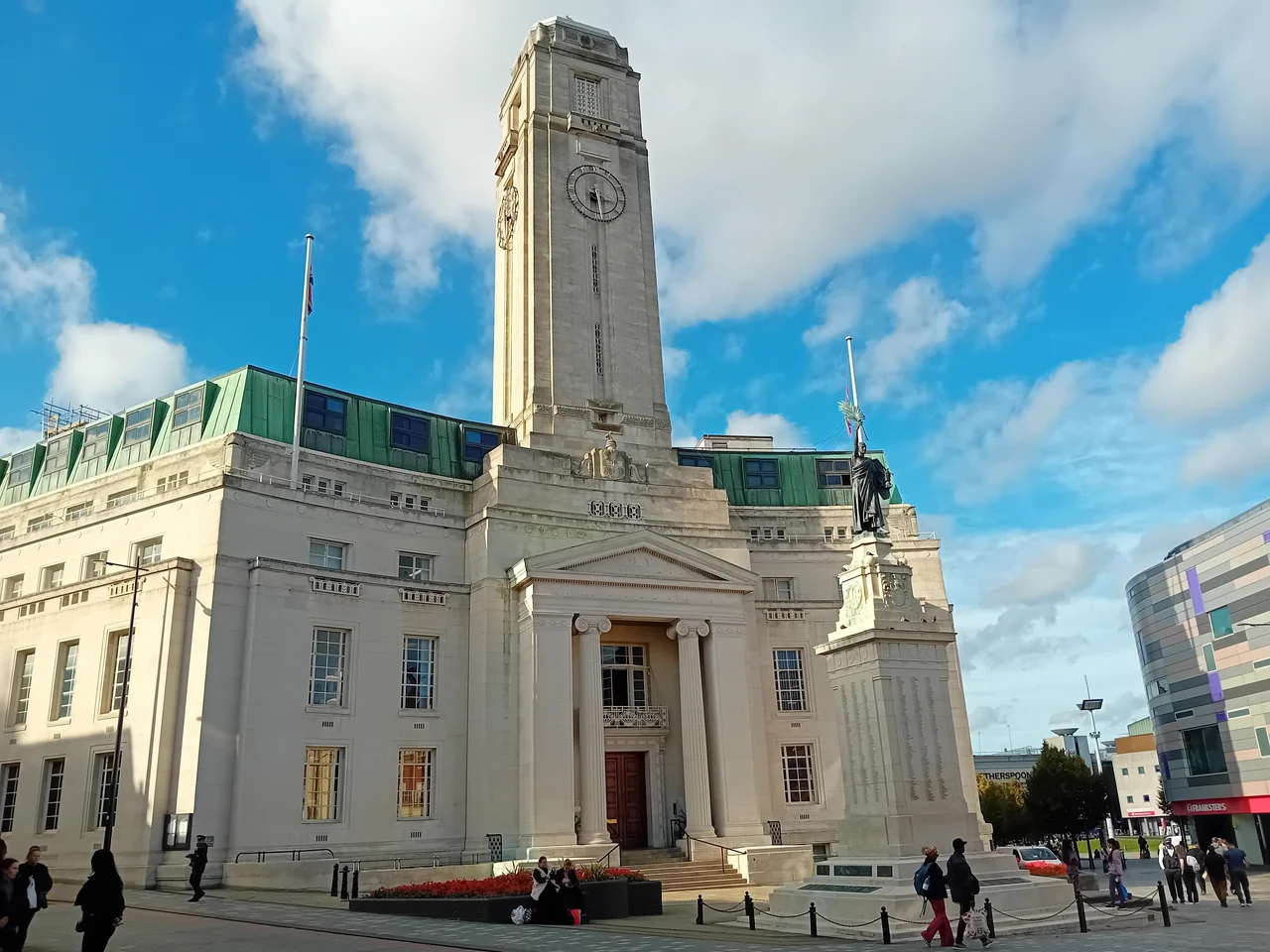
Luton Town Hall, 6 October 2023. Richard Kelly / Wikimedia Commons. CC BY-SA 4.0. Resized for display and cropped to fit. Homepage photographs also have a dark gradient and text overlay. Original and photographic adaptations: CC BY-SA 4.0.

Research and production assisted by AI. Read our approach
Have evidence that could change this finding? Contact TALLYCAT01